


Page 215 - KBHA BULLETIN 6
P. 215
For the fishermen and other "non-Europeans" in Kalk Bay, this idyllic spot was far from

                  healthy. Indeed, its record is worse than that of most of the other wards in Cape Town. The

                  1918 flu hit this population hardest as well. And we should remember here that one of the
                  peculiarities of the 1918 'flu was that the age group which suffered most was that of young

                  adults,  i.e  the  most  economically  productive  sector.  The  'flu  left  behind  it  orphaned
                  children and single mothers, many of whom had no employment.


                  Living conditions in Kalk Bay


                  So why was the health of the poor so bad? The most important reason seems to be related
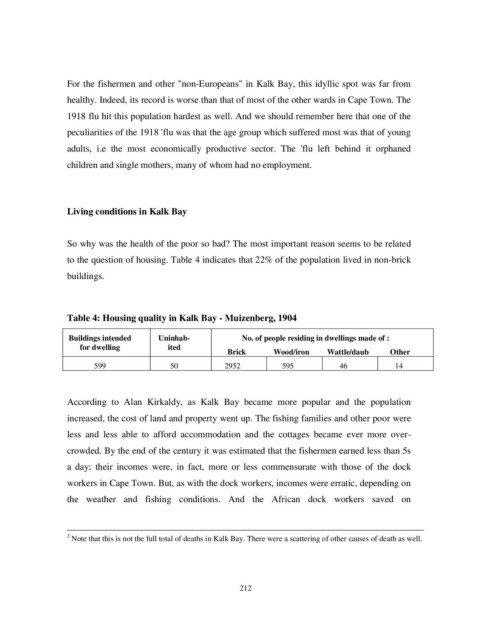
                  to the question of housing. Table 4 indicates that 22% of the population lived in non-brick

                  buildings.


                  Table 4: Housing quality in Kalk Bay - Muizenberg, 1904

                  Buildings intended     Uninhab-              No. of people residing in dwellings made of :
                     for dwelling           ited
                                                              Brick              Wood/iron         Wattle/daub           Other
                         599                50            2952           595            46            14


                  According  to  Alan  Kirkaldy,  as  Kalk  Bay  became  more  popular  and  the  population

                  increased, the cost of land and property went up. The fishing families and other poor were
                  less  and  less  able  to  afford  accommodation  and  the  cottages  became  ever  more  over-

                  crowded. By the end of the century it was estimated that the fishermen earned less than 5s

                  a  day;  their  incomes  were,  in  fact,  more  or  less  commensurate  with  those  of  the  dock
                  workers in Cape Town. But, as with the dock workers, incomes were erratic, depending on

                  the  weather  and  fishing  conditions.  And  the  African  dock  workers  saved  on


                  3  Note that this is not the full total of deaths in Kalk Bay. There were a scattering of other causes of death as well.


                                                              212

